
The complete guide
The Plain-English Guide to Buying an H1 Halogen Headlight Bulb
The moment you find out a bulb has gone
Usually it is someone else who tells you. A flash from an oncoming car, a comment from a passenger, or you reverse towards a garage door at night and notice only one bright patch instead of two. A blown headlight bulb is one of those small faults that goes from invisible to urgent in about a second, because driving on one headlight is both unsafe and the sort of thing that gets you pulled over.
The good news is that this is one of the few car jobs most people can still do themselves. A halogen bulb is a cheap consumable. It is designed to be swapped. The hard part is not the fitting, it is working out which bulb you actually need, and that is where most of the confusion lives.
What an H1 bulb actually is
It describes the physical shape of the bulb base, the position of the filament and the type of electrical connector. An H1 bulb has a single filament and a flat metal base with a single blade connector sticking out of it. Put one next to an H4 or an H7 and the difference is obvious within a second.
This matters because headlight housings are built around one specific bulb shape. The reflector or lens is designed assuming the filament sits in an exact spot. Put the wrong bulb in, even if you could somehow make it fit, and the beam pattern falls apart. You get glare where you do not want it and darkness where you do.
So the rule is simple. If the lamp currently uses an H1, an H1 goes back in. The best h1 fitting bulb for your car is the one that matches what came out.
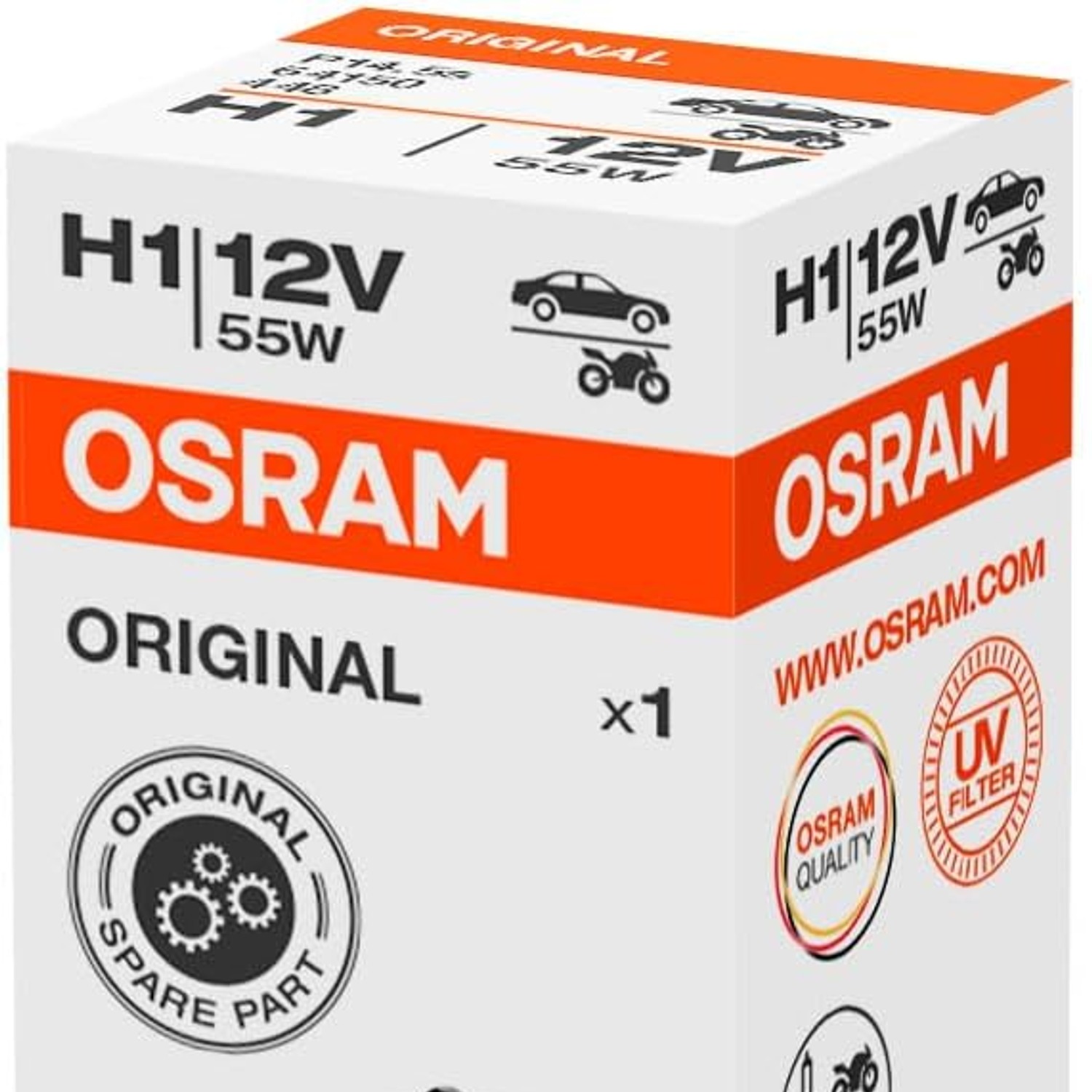
This one is 12 volts and 55 watts
Those two numbers are the other half of the specification. Twelve volts is the electrical system the bulb expects, which is what nearly every car and light van runs. Fifty-five watts is the power it draws when lit, and it is the standard figure for a very large number of halogen headlight bulbs.
Do not read wattage as a brightness score. It tells you how much electricity the bulb consumes, not how much usable light lands on the road. Those two things are related but not the same, and it is worth keeping them separate in your head when you are comparing options.
If your vehicle runs a 24 volt system, as some larger commercial vehicles do, a 12 volt bulb is not an option. It will fail the moment you switch on.
Checking before you order
There are two reliable ways to confirm the fitting, and neither takes long.
The first is the owner manual. It will say something like H1 for one position and a different code for another.
The second, and the one we would trust more, is to look at the old bulb. Open the bonnet, get to the back of the headlight, release the bulb and read the base. The code is printed or moulded right there. Hold it, read it, then order. If it says H1, this bulb has the matching fitting. If it says something else, stop and find the right one instead.
We can only confirm fitting type. We cannot tell you that a bulb fits a named car, because the same model can use different lamp units depending on year, trim and market. Reading your own bulb removes all of that guesswork in about two minutes.
Fitting it without trouble
The sequence is the same on almost every car. Switch the lights off and let everything cool. Halogen bulbs run extremely hot in use, and a bulb you turned off thirty seconds ago will burn you. Give it a few minutes.
Then unclip the connector from the back of the bulb. Release whatever holds the bulb in, which is usually a sprung wire clip you push and swing aside, or a collar you twist a quarter turn. Lift the old bulb out, noting which way round it sat. Seat the new one so the locating tabs drop into their slots, refit the clip or collar, push the connector back on, and test it before you close the bonnet.
If the bulb will not seat, do not force it. Nine times out of ten it is rotated a few degrees and the tabs are riding on the edge of the slots. Pull it out, turn it slightly and try again.
On some modern cars access is genuinely awkward and you may need to remove a battery cover, an air intake duct or part of a wheel arch liner to get a hand in. That is a design problem, not a bulb problem. If you cannot reach, a garage will do it quickly.
The one habit that matters
Keep your bare fingers off the glass. The quartz envelope of a halogen bulb gets very hot, and oil from skin bakes onto the surface and creates a hot spot that can shorten the bulb's life. Hold the metal base. Better still, leave the plastic sleeve on until the bulb is almost in position, then slide it off.
If you do touch it, there is an easy fix. Wipe the glass with a lint-free cloth and a little methylated spirit, let it dry completely, then fit it. No drama.
One bulb or two
Bulbs fail one at a time, and plenty of people only want to replace the one that has gone.
That said, there is a sensible argument for doing both. The two bulbs on your car have usually spent the same number of hours switched on, so when one goes, the other is often not far behind. Changing the pair also keeps the light output on each side looking consistent, which is more noticeable than people expect once one side has been renewed. If that appeals, simply order two.
A third option, and the one we would quietly recommend to anyone driving an older car, is to buy one for the car and one for the glovebox. The best value headlight bulb is the one already in your boot when a bulb blows on a dark Sunday evening.
Storing a spare properly
A spare bulb is only useful if it survives until you need it. Leave it in its packaging, which is designed to keep the glass clean and protected. Store it somewhere dry and where it will not roll around and get knocked. A glovebox, a door pocket or a padded compartment in the boot all work.
Avoid loose storage in a toolbox where spanners can land on it. Quartz glass is tougher than it looks, but it is still glass.
When a new bulb does not fix it
Occasionally you fit a new bulb and nothing happens. Before you assume the bulb is faulty, check two things. First, that the connector is pushed fully home, because it is easy to leave it half seated when you are working blind. Second, the fuse for that circuit.
If the connector is sound and the fuse is good, and the other headlight still works normally, the fault is probably in the wiring, a relay or the switch rather than in the bulb. At that point it is a job for someone with a multimeter.
The short version
An H1 halogen headlight bulb is a simple, inexpensive consumable part. This one is rated 12 volts and 55 watts and comes as a single bulb. It suits a lamp that already uses an H1 bulb, and the only reliable way to confirm that is the owner manual or the code on the base of your old bulb.
Fit it without touching the glass, let a used bulb cool before you handle it, and keep a spare in the car. If you are not certain which fitting you need, send us the code from your old bulb and we will tell you whether this is the match before you spend anything.